From 3 February to 4 May 2026, the British Museum will present the exhibition Samurai, one of the most ambitious shows in its recent programme, which promises to revisit the legendary image of Japan’s warriors through a historical, critical and contemporary reading. Staged in the Sainsbury Exhibitions Gallery (Room 30), the exhibition invites visitors to discover the complex evolution of this figure between medieval reality and modern myth, revealing the cultural, political and symbolic transformations that have accompanied it for more than a millennium. At Arte.News we believe that the British museum’s project not only recovers the material culture of an era, but also questions the way the West has mythologised and consumed its visual legacy.
The exhibition begins with the rise of the bushi warrior class in twelfth-century Japan, when the samurai came to occupy a central role in political and military power. However, the show highlights a turning point: the start of the period of peace in 1615, when the samurai gradually left the battlefield to become a social and cultural elite, in which poetry, painting and philosophy coexisted with the sword. This shift from warrior to intellectual offers a broader reading of the samurai ideal, in which mastery of the body is complemented by discipline of the spirit.
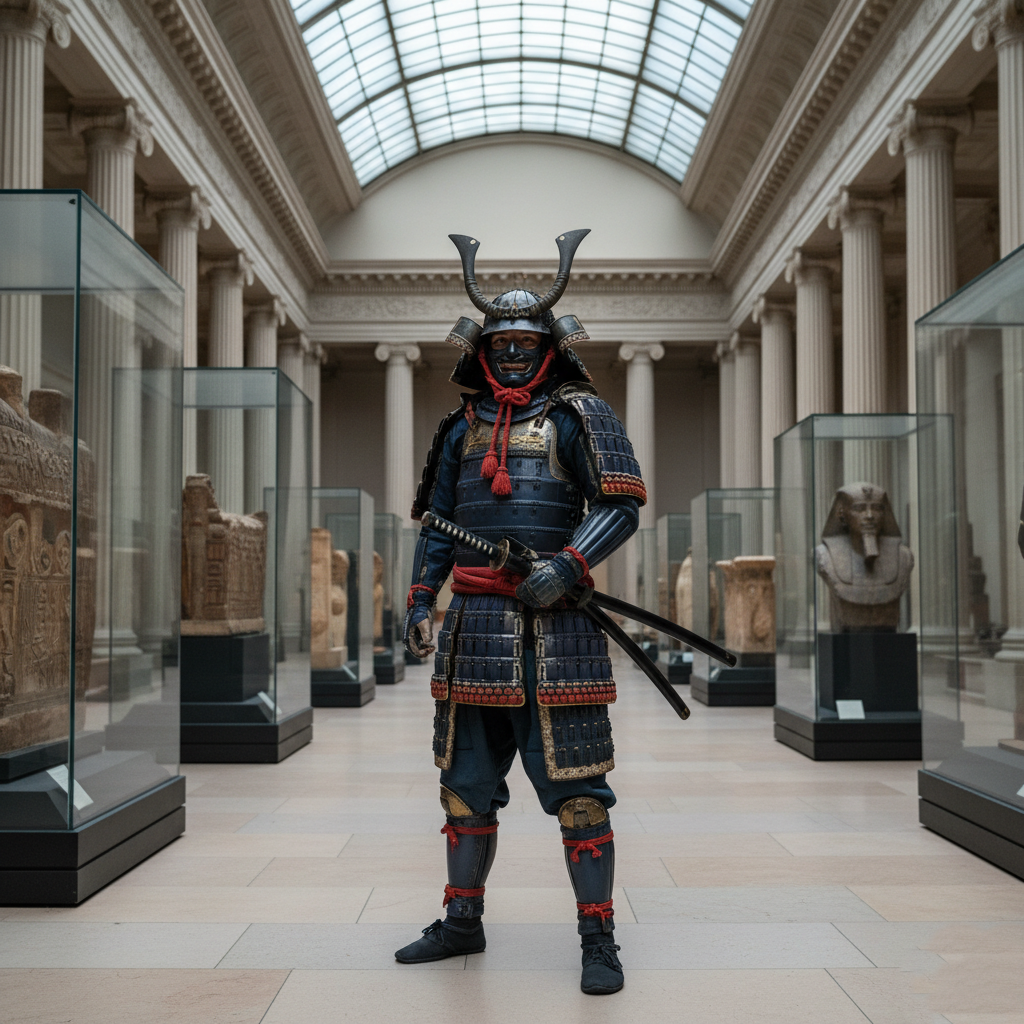
Among the highlights is the armour sent by Tokugawa Hidetada to King James VI and I, a symbol of diplomatic exchange between Japan and Europe in the seventeenth century, as well as an incense set that reveals the sensory and ritual refinement of the samurai aristocracy. The exhibition also opens a dialogue with contemporary visual culture: from a Louis Vuitton collection inspired by Japanese armour to references to the world of video games, such as Assassin’s Creed: Shadows, and to global cinema, which has reinterpreted the figure of the warrior in epic or romantic tones.
Here the British Museum offers an exercise in demythologisation that goes beyond exoticism: an attempt to restore humanity and historical complexity to the men and women who belonged to this caste. As the curatorial text points out, the term bushido —the “way of the warrior”— was not an ancestral code but a later ideological construct, used during Japan’s modernisation in the nineteenth century and its imperialist expansion to foster an ideal of patriotism and sacrifice. In this sense, Samurai reveals how images of honour and discipline were instrumentalised, becoming national mythology and, later, global iconography.
At Arte.News we believe this exhibition offers an essential reading of how cultural myths are constructed and how contemporary societies inherit and transform those fictions. By bringing together armour, ritual objects and contemporary design pieces, the British Museum draws a continuous line between the medieval warrior and the twenty-first-century media icon, showing that the figure of the samurai remains a mirror of the values —and contradictions— of each age.
Originally published in Spanish by Arte.News: El British Museum desmonta el mito del guerrero: “Samurai”, una mirada crítica a mil años de historia japonesa