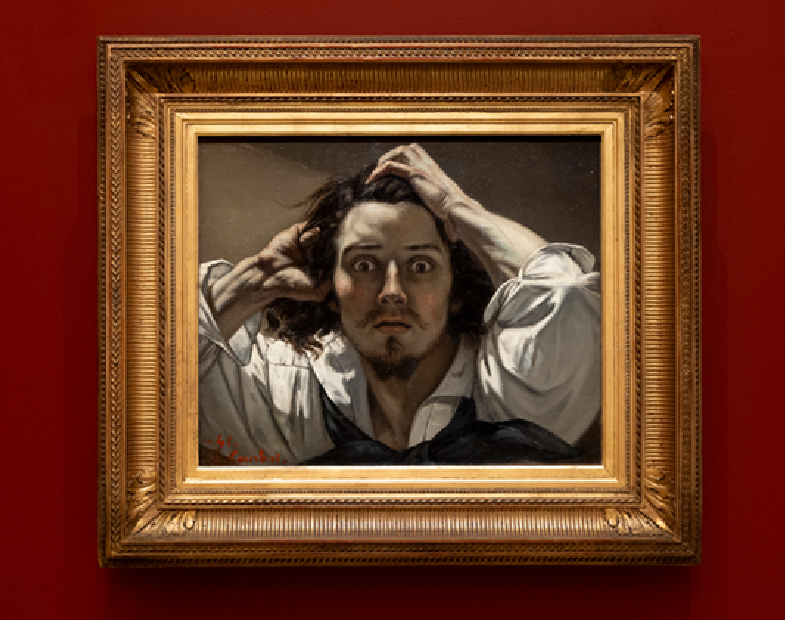
The Musée d’Orsay has just temporarily added to its galleries one of the most emblematic paintings of the nineteenth century: Gustave Courbet’s Self-Portrait, known as The Desperate Man (Le Désespéré, 1844-1845). The arrival of this masterpiece in Paris is the result of an exceptional loan agreement between the French museum and Qatar Museums, the institution that owns the canvas. The agreement, signed in Doha during the official visit of French Culture Minister Rachida Dati, is part of a new framework for cultural cooperation between the two countries. The loan also carries a profoundly human meaning: it is dedicated to the memory of Sylvain Amic, president of the Musée d’Orsay and the Musée de l’Orangerie, who died recently and was a recognised specialist in Courbet’s work.
For Arte.News, this event goes beyond the mere circulation of a painting: it is an opportunity to reconsider the power of the image and the role of the artist in an age of transformation. The Desperate Man had not been seen in France since the major retrospective that travelled to Paris, New York and Montpellier in 2007-2008. Its return to the Orsay is, in many ways, the return of Courbet himself to the heart of French art history.
Between 1842 and 1855, Gustave Courbet painted and drew some twenty self-portraits. But none reached the intensity or the audacity of The Desperate Man. In this image, the young artist depicts himself with bulging eyes, mouth half-open and hands clenched in his hair, in a gesture that seems to border on madness. The tight framing, the violent lighting and the overwhelming expression give the canvas an energy that bursts beyond the Romantic framework of the nineteenth century. Courbet, still at the start of his career, seems to look at himself —and at us— from the edge of the abyss. The painting is not a simple psychological study: it is a declaration of existence, a cry of affirmation in the face of the void.
This work, executed when Courbet was just 25, remained in his possession until his death. Unlike other self-portraits that he exhibited publicly, The Desperate Man stayed hidden for decades, as if the artist had wished to keep his most vulnerable and tormented side to himself. Only in 1873, while living in exile in Switzerland after his involvement in the Paris Commune, did he decide to show it in Vienna under the title Self-Portrait of the Artist. It was then that he added his signature in red and the falsely early date of 1841, a gesture which, according to some scholars, reflects his desire to turn the image into a symbol of lost youth and suffering. Years later, shortly before his death, he exhibited it in Geneva under a title that said it all: Desespoir.
At Arte.News we read this painting not only as an intimate scene, but as a manifesto of the modern artist. Courbet portrays himself caught between lucidity and vertigo, between pride and anguish, anticipating the tragic condition of the creator in the nineteenth century. The expressive intensity of his face, the theatricality of the gesture and the mystery surrounding the scene have made The Desperate Man a universal image: a mirror of the human soul confronting itself. It is no coincidence that critics and philosophers consider it one of the first representations of the modern self in Western painting.
At the Musée d’Orsay, the work has been installed in Room 4, at the start of the main circuit, alongside paintings by Jean-François Millet and Honoré Daumier, artists who, like Courbet, explored the links between art and the social revolutions of the nineteenth century. The placement is far from incidental: the painting converses with the birth of Realism, the movement that Courbet himself championed as an alternative to academic idealism. Its presence also strengthens the core of the museum’s collection, which holds other key self-portraits by the artist, such as The Man with the Leather Belt (1846) and The Wounded Man (1855), as well as his masterpiece The Painter’s Studio.
The loan of The Desperate Man comes with a story of collaboration between institutions that symbolises global cultural dialogue. As announced by Sheikha Al Mayassa bint Hamad bin Khalifa Al Thani, chairperson of Qatar Museums, the painting will remain at the Orsay until the opening of the Art Mill Museum in Doha, devoted to modern and contemporary art. Thereafter, the painting will alternate between Paris and the Qatari capital, building an artistic bridge between Europe and the Middle East. A gesture that, in the Sheikha’s own words, “pays tribute to the spirit of cooperation that Sylvain Amic championed”.
The arrival of The Desperate Man in Paris, almost two centuries after it was painted, invites us to reconsider Courbet’s place in history: that of an artist who rejected dogma, who painted without compromise and who understood art as an act of freedom. His self-portrait, with its overflowing gaze and contained tension, continues to challenge the viewer with the same force it did in the nineteenth century.
Today, at the Musée d’Orsay, standing before that face which seems to cry out against fate, one understands that the despair Courbet speaks of is not merely a state of mind: it is the vital energy of a creator who made art a form of resistance.
Originally published in Spanish by Arte.News: El Desesperado de Courbet regresa a París: el grito de un artista que desafió su tiempo