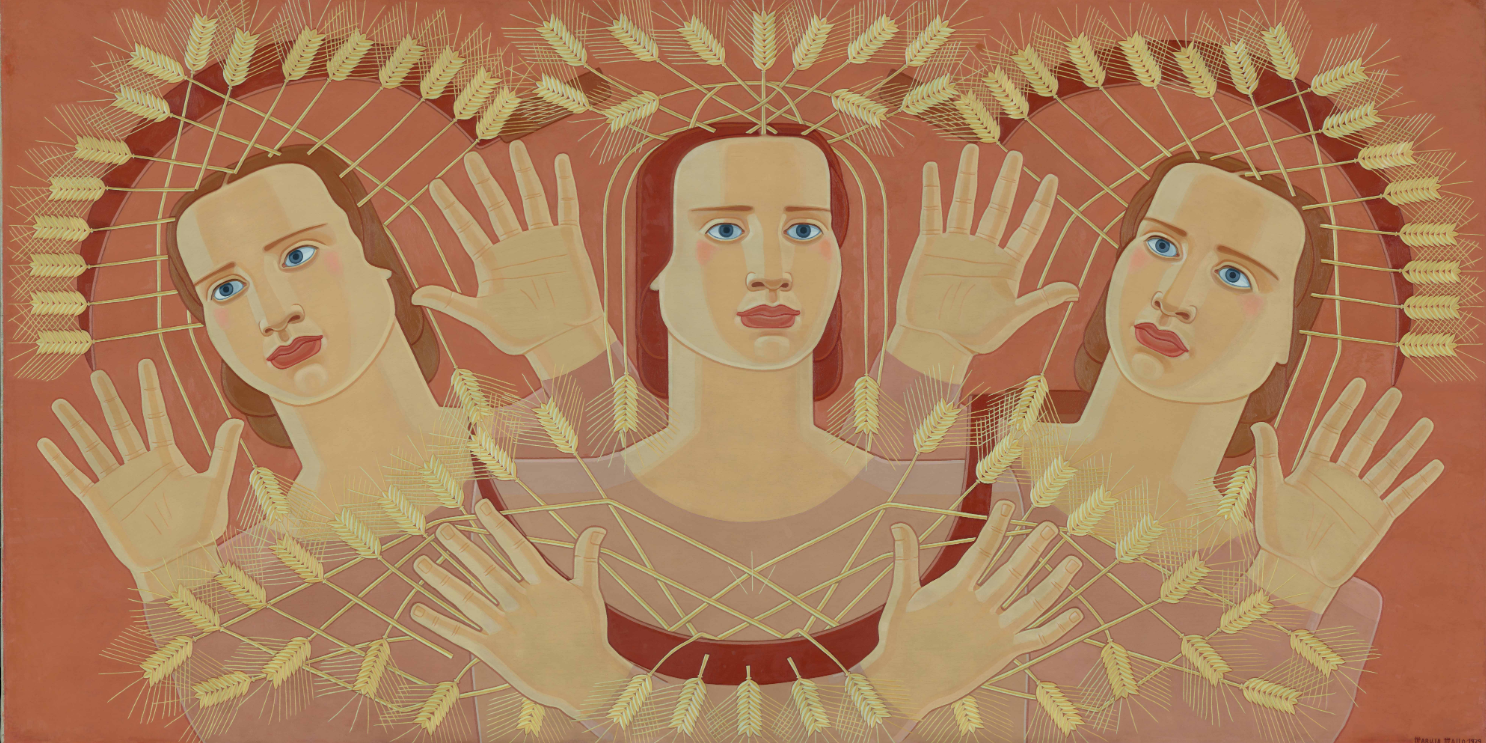
From 8 October 2025 to 16 March 2026, the Museo Reina Sofía is hosting the largest retrospective ever devoted to Maruja Mallo (Viveiro, Lugo, 1902 – Madrid, 1995), in collaboration with the Fundación Botín. Entitled Mask and Compass (Máscara y compás), the exhibition —curated by Patricia Molins— brings together more than a hundred paintings, seventy drawings and a wealth of documentary material, much of it previously unseen, tracing the life and artistic journey of one of the most unclassifiable figures of the Spanish avant-garde.
The title refers to two threads running through all her work: the compass as a symbol of the geometric order that governs her pictorial structure, and the mask as a metaphor for the tension between the living and the inanimate, between ephemeral nature and its eternal representation. At Arte.News we believe that this duality holds the key to Mallo’s visual thinking: an artist who found in form and colour a path to knowledge as rational as it was poetic.

The exhibition, which occupies eleven rooms in the Sabatini Building, allows visitors to rediscover the many metamorphoses of an artist who combined modernity, commitment and exile. From her celebrated Verbenas (1927-28), which united magical realism and popular culture with a spirit of social satire, to her unsettling Cloacas y campanarios (Sewers and Belfries, 1929-32), where matter becomes a symbol of decay, Mallo always explored the intersection of art and life. Masterpieces such as The Scarecrow (El espantapájaros) —acquired in its day by André Breton— and the recovered Arquitectura fósil I (Fossil Architecture I) bear witness to that search between the telluric and the spiritual.
The show also covers her work as a set designer and photographer, in which the female body becomes a territory of emancipation. Mallo portrayed herself as the actress of her own modernity: in abandoned railway carriages, on American beaches or in front of her paintings, reinterpreting her identity as an artist and as a woman. Her Máscaras (Masks) and Cabezas (Heads) of the 1940s, made during her exile in Latin America, fuse cultures, races and genders in a symbolic language that anticipates contemporary debates on mestizaje and identity.

The exhibition culminates with her late series Moradores del vacío (Dwellers of the Void) and Viajeros del éter (Travellers of the Ether), in which the cosmos and geometry take the place of the earth and the body. In them, Mallo turns science into pictorial matter and the universe into an abstract theatre of light and metamorphosis. These are visions that, as the artist herself wrote, arise from her “materialist faith in the harmonic order of numbers” and her fascination with the fourth dimension.
The Museo Reina Sofía and the Fundación Botín accompany the exhibition with a bilingual catalogue and an extensive public programme that includes lectures on art and exile with Estrella de Diego and Alejandra Zanetta, as well as the mediation project Mallo Más Allá, designed to broaden the reading of her legacy among different audiences.
For Arte.News, this retrospective not only restores Maruja Mallo to her rightful place in the history of modern art, but also champions a way of thinking about painting as a vital system, in which reason and desire, science and poetry, coexist without contradiction. Her work, profoundly feminine and universal, traces a genealogy of Spanish art in a cosmic key: from the ground to the stars, from the body to number, from gesture to idea.
Originally published in Spanish by Arte.News: Maruja Mallo: el orden geométrico del caos