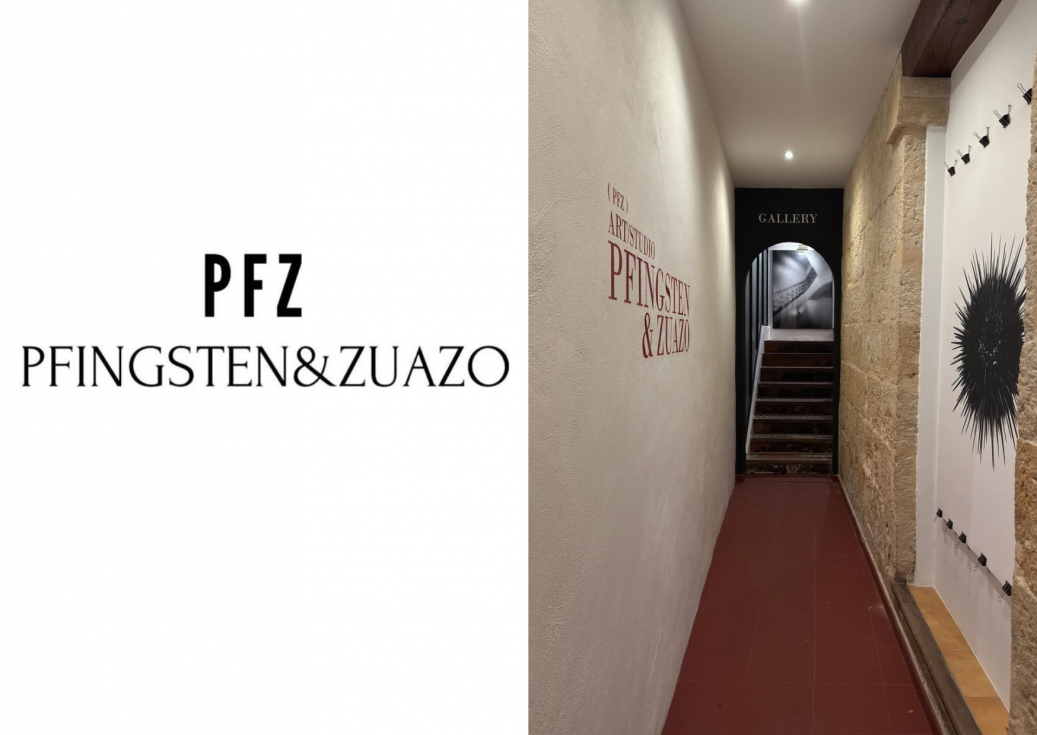
The Historic Centre of Xàbia gains a new cultural landmark with the opening of PFZ.ART, a gallery founded by Susanne Pfingsten and Julián Zuazo. Housed in a stately building dating from 1867, next to the Soler Blasco Museum, the space not only broadens the town’s art offering but also sets out a clear manifesto: to make art a bridge between Mediterranean nature, local memory and the challenges of the present.
At Arte.News we have watched Xàbia consolidate, in recent years, a cultural scene that seeks to balance tradition and contemporaneity. Pfingsten and Zuazo’s project embodies precisely that productive tension. This is not a neutral “white cube”, but a space restored with respect for its original architecture —hydraulic tile floors, staircases, painted ceilings— that acts as a framework for dialogue between past and present.
The statement of intent is explicit. In the gallerists’ words: “A path born of Mediterranean nature, of the coast we inhabit and that inhabits us.” We read this premise as a call to the invited artists: what is expected here is not indifferent work, but creation that allows itself to be shaped by the territory, by its light, its contrasts and also its wounds.
The opening exhibition confirms it. Under the title Majestic from above, cruel from below, physicist, astronaut and photographer Ed Lu presents striking images of storms captured in 2003 from the International Space Station. These images converse with a series by Julián Zuazo marked by the memory of the DANA storm that battered Valencia and its surroundings. The contrast between cosmic beauty and earthly devastation creates a twofold narrative: the grandeur of nature and human vulnerability.

It is no accident that this duality is PFZ.ART’s starting point. At Arte.News we see it as a conceptual statement: the gallery does not want merely to exhibit, but also to challenge, to compel viewers to think about the fragility of the world they inhabit. And it does so from a very local perspective —the tears of Xàbia’s quintas, the traditional costume— out to a global horizon —storms seen from space.
Zuazo’s second project, There is no artist greater than nature, takes this outlook further. With images ranging from the monumental —the Montgó turned into a “Sleeping Elephant”— to the microscopic —the texture of a sea urchin—, his work shows that nature does not merely inspire: it is, in itself, the greatest artist.
The gallery opens its doors at a time when Xàbia is seeking to establish itself as a cultural benchmark in the Valencian Community. With the Ojos Rojos festival as a platform and an exhibition calendar that is already ambitious, PFZ.ART is shaping up as a force for renewal. At Arte.News we believe its strength lies in more than the quality of its shows: what will be decisive is its ability to become a meeting place, a space where tradition, nature and contemporary art recognise one another.

In short, the opening of PFZ.ART is not just the launch of a new gallery: it is a cultural gesture that aspires to reshape the identity of Xàbia’s old town. And although the official opening is scheduled for 24 October, as part of the Ojos Rojos festival, the space already pulses with the promise of becoming a point of reference for artists and visitors alike.
Gutiérrez, D. (2025, August 11). Nace PFZ.ART una nueva galería de arte en el corazón del Centro Histórico de Xàbia. Noticias de Xàbia.
Originally published in Spanish by Arte.News: PFZ.ART: una nueva galería que transforma el corazón histórico de Xàbia